

If you have a child in Australian primary or secondary school, you have almost certainly heard the word NAPLAN. It comes up at school nights, in newsletters, and sometimes causes a surprising amount of anxiety in both students and parents alike. But what is NAPLAN, exactly? What does it measure, when does it happen, and — perhaps most importantly — how much does it really matter? This complete parent's guide answers every question about the National Assessment Program – Literacy and Numeracy in plain language, so you can approach it with confidence.
What Is NAPLAN?
NAPLAN stands for National Assessment Program – Literacy and Numeracy. It is a standardised national assessment administered to students in Years 3, 5, 7, and 9 across every Australian state and territory. The program is managed jointly by ACARA (the Australian Curriculum, Assessment and Reporting Authority) and state and territory education authorities.
NAPLAN was introduced in 2008 with two key goals:
- To give parents, teachers, and schools a consistent national picture of student achievement in core literacy and numeracy skills.
- To help governments and education systems identify where targeted support and resources are needed at a school and system level.
Importantly, NAPLAN is a snapshot assessment, not a comprehensive exam. It captures a moment in time and covers a specific set of foundational skills — it does not assess science, history, arts, sport, or the full breadth of what your child learns at school.
Over 1.3 million Australian students sit NAPLAN every year. Since 2023, the test moved from May to March, and all students now complete it online (with paper-based exemptions available for specific needs).
Which Year Levels Sit NAPLAN?
NAPLAN is conducted in four specific year levels, chosen to track student progress at key stages of schooling:
| Year Level | Typical Student Age | Stage of Schooling |
|---|---|---|
| Year 3 | 8–9 years old | Mid-primary (after 3–4 years of school) |
| Year 5 | 10–11 years old | Upper primary (approaching end of primary) |
| Year 7 | 12–13 years old | Early secondary |
| Year 9 | 14–15 years old | Mid-secondary |
The selection of these four year groups allows educators and policy makers to track growth over time — for example, comparing a student's Year 5 result with their Year 7 result to measure individual progress. This longitudinal data is one of NAPLAN's most valuable features.
What Does NAPLAN Test?
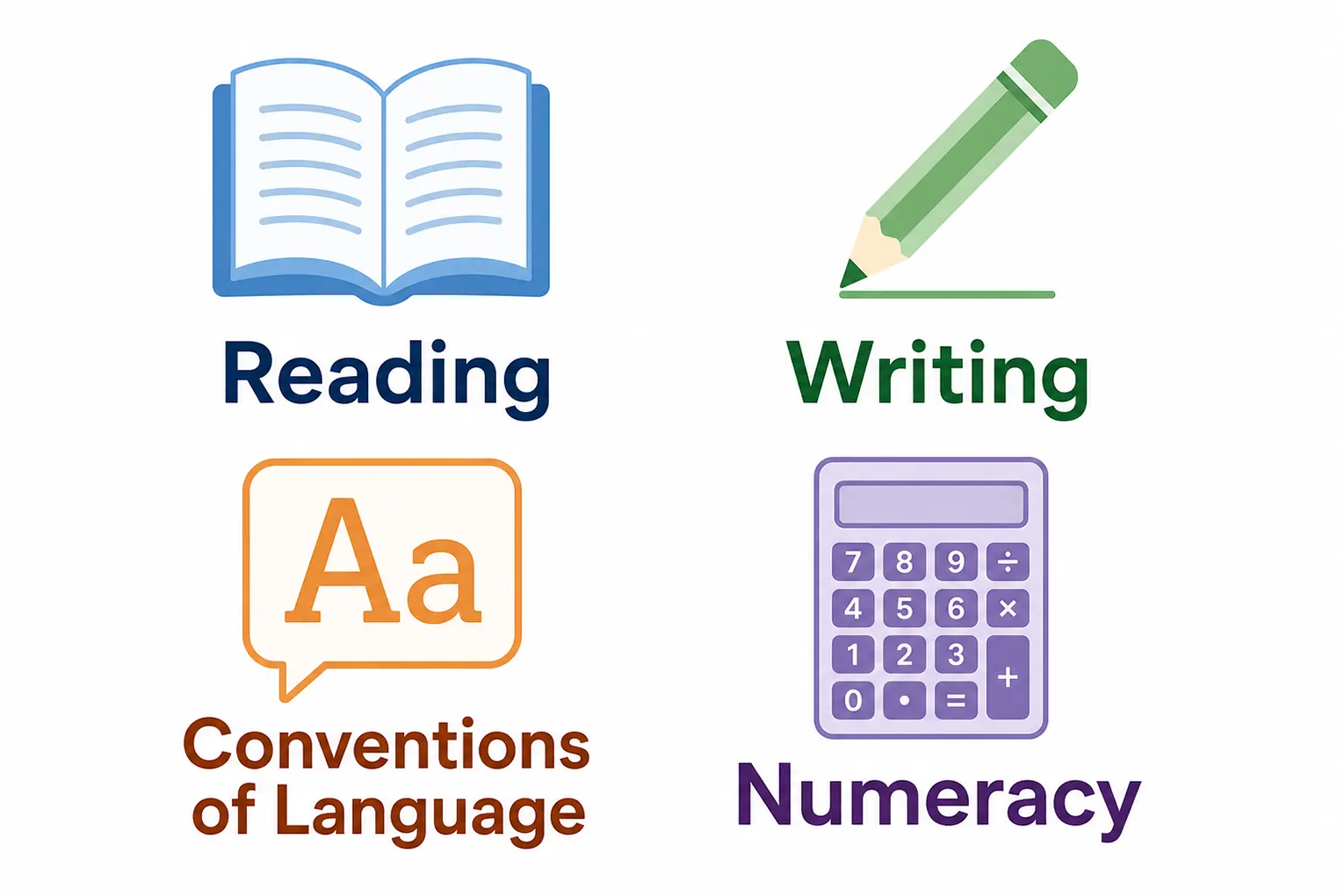
NAPLAN tests four specific domains that are considered foundational to all areas of learning:
Literacy
The literacy component of NAPLAN is divided into three assessments:
- Reading: Students read a series of texts — including fiction, non-fiction, poetry, infographics, and persuasive pieces — and answer comprehension questions. These test skills such as inferencing, identifying the main idea, understanding vocabulary in context, and evaluating authorial purpose.
- Writing: Students complete a single extended writing task. The prompt asks them to write either a persuasive or narrative piece. Assessors evaluate structure, vocabulary, grammar, punctuation, and spelling.
- Conventions of Language: This section assesses spelling, grammar, and punctuation through targeted questions. It replaced the separate "spelling" and "grammar and punctuation" subtests when NAPLAN moved fully online.
Numeracy
The numeracy test assesses students' ability to apply mathematical reasoning across a variety of real-world contexts. It draws on content from the Australian Curriculum mathematics strand, covering:
- Number and Algebra
- Measurement and Geometry
- Statistics and Probability
Students in Years 7 and 9 may use a calculator for part of the numeracy assessment. Year 3 and Year 5 students complete numeracy without a calculator.
When Is NAPLAN Conducted in 2026?
Since 2023, NAPLAN has been held in March rather than May, moving it closer to the start of the school year. In 2026, NAPLAN is scheduled for the second full week of March — typically around 11–21 March. The exact dates are confirmed by ACARA and communicated to schools well in advance.
The shift to March means that results are returned to schools and families much earlier in the year — usually by May or June — giving teachers more time to act on the data and support students throughout the current school year, rather than at its end.
NAPLAN is now conducted entirely online on school devices. In the weeks before the test, ensure your child is comfortable typing — especially for the writing task, which requires extended text entry. Practising on a keyboard (not just a touchscreen) at home can reduce day-of anxiety.
Understanding the New NAPLAN Results System (2023–2026)
In 2023, NAPLAN underwent its biggest change since launch: the old ten-band scoring system was replaced with a four-level proficiency scale. This new format is clearer for parents, more actionable for teachers, and better aligned to what students are expected to achieve at each year level.
The four proficiency levels are:
| Proficiency Level | What It Means |
|---|---|
| Exceeding | The student's result exceeds the level expected at that year level. They demonstrate advanced skills for their stage. |
| Strong | The student's result demonstrates a sound and thorough understanding at the expected level. This is the goal for most students. |
| Developing | The student is working towards the expected level. Some foundational skills are in place but further development is needed. |
| Needs Additional Support | The student has not yet demonstrated the literacy or numeracy skills expected at this year level and may benefit from targeted assistance. |
The previous NAPLAN band system (Bands 1–10) was criticised for being difficult to interpret. The new four-level proficiency model was designed to answer a simple question: Is my child at, above, below, or well below the expected standard? Research shows parents find this format significantly more understandable.
Your child's NAPLAN report will also include a numerical score alongside their proficiency level, which allows for more granular tracking of growth over the years. When comparing scores across year levels (for example, Year 5 vs. Year 7), the numbers are on the same scale, so progress can be measured directly.
How to Prepare Your Child Without Creating Anxiety
NAPLAN is a routine part of Australian schooling, and teachers do prepare students for the style and format of the test throughout the year — not through "teaching to the test," but through good literacy and numeracy instruction. As a parent, your most powerful contribution is to support your child's confidence and reduce anxiety.
For Year 3 and Year 5 Students
- Read together daily: Strong reading comprehension skills are built over years of reading, not weeks of cramming. Reading a variety of texts — fiction, non-fiction, news articles — sharpens the skills NAPLAN tests.
- Practise writing for different purposes: Encourage your child to write short stories, persuasive letters, or diary entries. This builds the writing muscles tested on the day.
- Play maths games: Number fluency — the ability to work quickly and accurately with numbers — underpins numeracy performance. Card games, mental maths challenges, and cooking together all help.
- Keep it calm and low-key: Avoid labelling NAPLAN as a "big test" or expressing anxiety about results. Children are remarkably sensitive to adult cues.
For Year 7 and Year 9 Students
- Review online practice tests: ACARA provides free publicly available NAPLAN practice tests online. These are the best preparation because they use the actual platform format.
- Focus on conventions: Students in secondary school often slip up on spelling and punctuation in formal writing. A quick daily review of common errors can lift the conventions score.
- Discuss the writing prompts: Practice structuring a persuasive argument: introduction, three supporting points, counterargument, and conclusion. Knowing this structure removes cognitive load on test day.
- Normalise the experience: Remind your teenager that NAPLAN does not affect their school grades, their ATAR, or their Year 12 results. It is a data collection exercise, not a career-defining moment.

How to Read Your Child's NAPLAN Report
NAPLAN reports are sent directly to families, typically through the school. Here is what you will find on the report:
- Your child's score in each of the four domains (Reading, Writing, Conventions of Language, Numeracy).
- Their proficiency level (Exceeding, Strong, Developing, Needs Additional Support) for each domain.
- The national average score for students at the same year level, so you can see how your child compares to peers nationally.
- Progress data (if your child has a previous NAPLAN record): a comparison showing growth since the last sitting.
If your child is in the Developing or Needs Additional Support category in any domain, request a meeting with their teacher. Ask specifically: "What strategies are being put in place at school, and what can we do at home to support progress?" Teachers appreciate proactive parents and will have targeted suggestions.
Does NAPLAN Affect My Child's Future?
This is the question that causes the most parental anxiety — and the answer, for the vast majority of students, is: not directly.
NAPLAN results do not:
- Affect classroom grades or school reports.
- Determine whether a student moves to the next year level.
- Contribute to the ATAR or any senior secondary certificate.
- Impact university admissions.
However, NAPLAN results can inform:
- Selective school applications: Some selective public high schools in NSW, Victoria, and Queensland use NAPLAN data as one component of their placement testing process.
- School-based support decisions: Teachers and school leaders use NAPLAN data to identify students who may benefit from additional literacy or numeracy support, extension programs, or learning adjustments.
- Long-term literacy tracking: If a student shows persistent underperformance across multiple NAPLAN sittings, it may prompt a referral for a more detailed learning assessment.
For most children, NAPLAN is simply one data point among many, and life goes on perfectly well regardless of the result.
What If My Child Is Below the Expected Level?
If your child's result falls in the Developing or Needs Additional Support category, take a breath — this is not a crisis. Here is a measured, practical response:
- Talk to the teacher: Your child's classroom teacher has the most complete picture. Discuss whether the NAPLAN result is consistent with day-to-day performance, or whether it was an outlier (perhaps the child was anxious, unwell, or had a technology issue on the day).
- Consider a targeted assessment: If there are consistent literacy concerns, a school learning support teacher or educational psychologist can conduct a diagnostic assessment to identify specific areas of difficulty, such as phonological processing, reading fluency, or working memory.
- Explore in-school support: Most Australian schools have reading recovery programs, literacy support teachers, and numeracy intervention programs available for students who need them. Ask what is available at your school.
- Consider structured tutoring: A qualified tutor who understands the Australian Curriculum can provide structured practice in the specific skills your child needs. Focus on quality over frequency — two sessions per week of targeted practice is more effective than daily drilling.
Can My Child Be Exempted From NAPLAN?
Yes, in specific circumstances. Schools can apply for an exemption from NAPLAN for students who:
- Have a significant intellectual disability that means the assessment is not appropriate for them.
- Are EAL/D students (English as an Additional Language or Dialect) who have been enrolled in an Australian school for less than one year.
- Require adjustments that cannot be accommodated (such as students with a vision or hearing impairment who require specialised formats).
Parents can also withdraw their child from NAPLAN on non-educational grounds (for example, on the basis of strongly held beliefs about standardised testing), but this is a relatively uncommon choice and the process requires a formal written request to the school principal.
Comparing School Results on the MySchool Website
The MySchool website publishes aggregated NAPLAN data for every Australian school, allowing parents to compare average results across schools in their area or across similar schools nationally. This can be a useful tool when choosing between schools — but it should be used carefully and in conjunction with other information.
On MySchool, you can view a school's NAPLAN results by year level and domain, compare results to statistically similar schools (schools with a comparable student population profile, based on ICSEA — the Index of Community Socio-Educational Advantage), and track a school's performance trend over time.
"Always compare a school's NAPLAN scores to its similar schools group, not just the national average. A school serving a high-needs community that is outperforming its similar schools is doing an exceptional educational job — and that tells you far more about teaching quality than raw score comparisons." — Eleanor Hastings, Education Consultant
For a deeper guide to navigating the MySchool website and interpreting its data, see our article on How to Use the MySchool Website (coming soon).
Key Takeaways for Parents
NAPLAN is a well-established part of Australian schooling that provides genuinely useful data — for teachers, schools, and families — when understood and used appropriately. It is not a pass/fail exam. It is not a predictor of your child's future success. And it is certainly not something worth losing sleep over.
The best thing you can do as a parent is maintain a positive, calm attitude about the assessment, support your child's literacy and numeracy development consistently throughout the year, and use the results — whatever they show — as a constructive conversation starter with your child's school.