
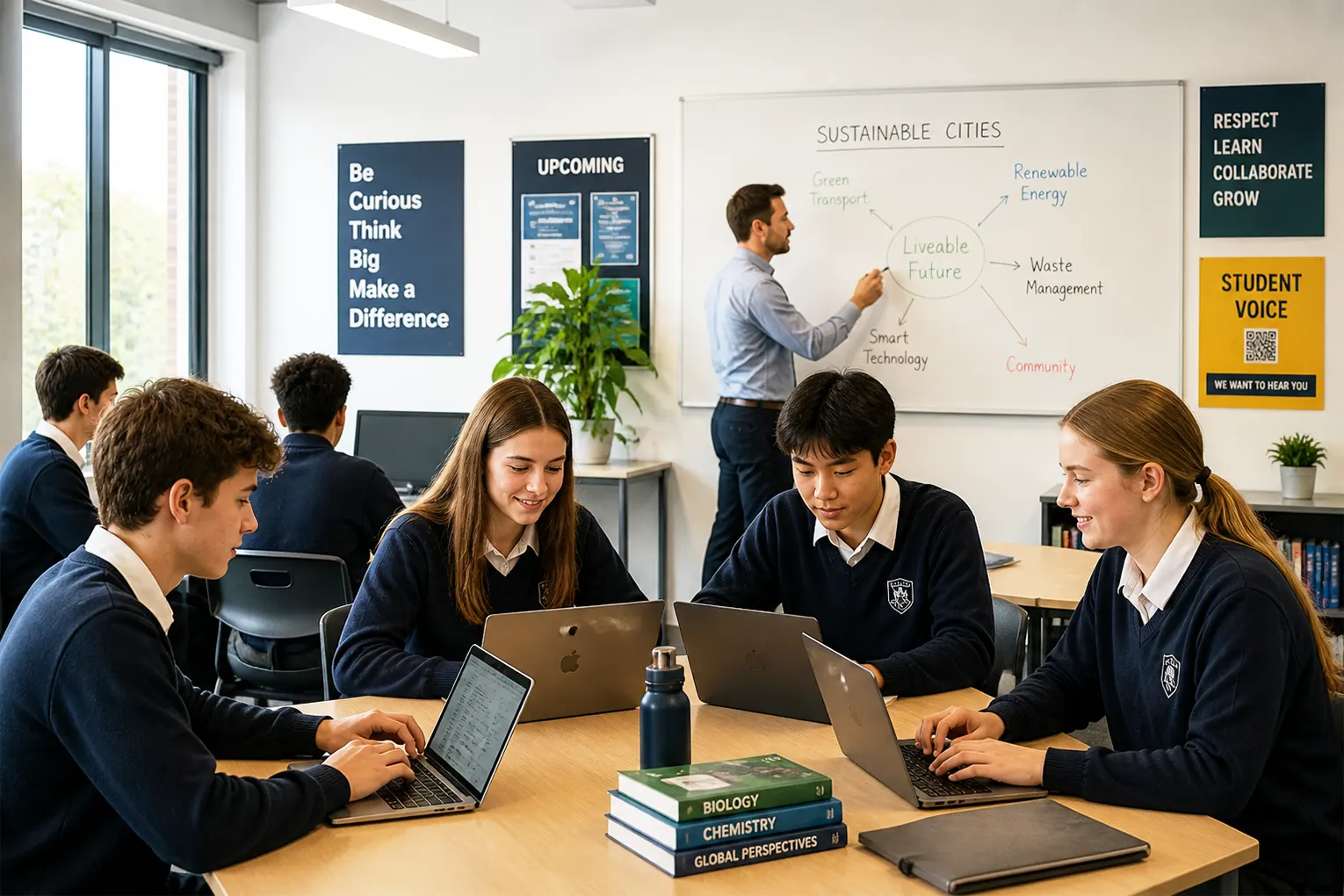
Junior Secondary Education in Australia — Years 7 to 10
Junior Secondary school in Australia spans Years 7 to 10, catering for students aged approximately 12 to 16. Often called "middle school" or the "junior years", this phase bridges the structured environment of primary school with the specialised, subject-focused senior years.
Junior Secondary students follow the Australian Curriculum across all key learning areas, while increasingly beginning to explore elective subjects that align with their individual interests and future pathways. It is a pivotal time developmentally, academically, and socially — and the right school environment makes a critical difference.
Age Range
Ages 12–16, covering Years 7 through to Year 10.
Curriculum
Australian Curriculum (Years 7–10) with electives introduced from Year 9.
NAPLAN
National assessments sat in Years 7 and 9 (Term 1 each year).
Pathway
Leads into Senior Secondary (Years 11–12) and subject specialisation.
Subjects in Years 7–10
Junior Secondary students study across all 8 learning areas of the Australian Curriculum. As students progress from Year 7 to Year 10, teaching becomes increasingly subject-specialist, with dedicated teachers for each discipline.
Core Subjects (Years 7–10)
- English — Literature, language study, creative and analytical writing, media literacy.
- Mathematics — Number, algebra, geometry, statistics and financial mathematics.
- Science — Biology, chemistry, physics and Earth sciences through inquiry-based learning.
- History — World history, ancient civilisations, and modern Australian history.
- Geography — Environments, human geography and sustainability.
- Health & Physical Education — Wellbeing, sport, personal development and movement.
Elective Subjects (typically from Year 9)
- Languages — Mandarin, French, Italian, Japanese, Indonesian, Spanish and more.
- The Arts — Visual Art, Drama, Music, Dance, Media Arts.
- Technologies — Digital Technologies, Food Technology, Design, Engineering, Wood/Metal Work.
- Commerce & Business — Business studies, economics, entrepreneurship (varies by school).
- Specialist subjects — Extension Maths, Agriculture, Child Studies, Photography, Sports Science.
NAPLAN in Junior Secondary
Students in Year 7 and Year 9 sit NAPLAN in Term 1. Results are used to identify learning strengths and areas needing support. Year 9 NAPLAN is the final NAPLAN assessment students will ever sit — it's also a key benchmark used by some selective senior schools for entry. Results are published on the My School website (myschool.edu.au).
Junior Secondary by State & Territory
While Years 7–10 is the standard junior secondary range across Australia, there are some structural differences in how schools organise these years:
| State | Junior Secondary Years | Ages | NAPLAN Years | Notes |
|---|---|---|---|---|
| NSW | Years 7–10 | 12–16 | 7 & 9 | Year 7 starts high school; RoSA awarded at Year 10 |
| VIC | Years 7–10 | 12–16 | 7 & 9 | Some schools use "Middle School" Years 7–9 |
| QLD | Years 7–10 | 12–16 | 7 & 9 | Year 7 moved to secondary in 2015 |
| WA | Years 7–10 | 12–16 | 7 & 9 | Some schools offer a distinct Middle School campus |
| SA | Years 7–10 | 12–16 | 7 & 9 | Year 7 in secondary since 2022 |
| TAS | Years 7–10 | 12–16 | 7 & 9 | Years 7–8 sometimes in middle school structure |
| ACT | Years 7–10 | 12–16 | 7 & 9 | Distinct high school campuses (Years 7–10) |
| NT | Years 7–10 | 12–16 | 7 & 9 | Combined schools common in remote communities |
Preparing for Senior Secondary — Year 10 Choices
Year 10 is a critical transition year. Students begin to shape their senior school pathway by:
- Subject selection — Choosing Year 11 subjects that align with ATAR goals or vocational interests.
- School change decisions — Some students move to a different school for Years 11–12 (e.g. a specialist senior college in ACT, or a more academically focused school).
- VET pathways — Vocational Education and Training (VET) subjects can begin in Year 10 at many schools, offering industry-recognised certificates.
- Work experience — Many Year 10 students complete 1–2 weeks of structured workplace learning.
- Selective entry applications — Some specialist senior schools (e.g. James Ruse, Melbourne High, MacRobertson Girls) require applications in Year 10.
Tips for Parents of Year 7–10 Students
- Stay engaged — Adolescents still need parental support; maintain open conversations about school, friendships and wellbeing.
- Monitor NAPLAN results — Use Year 7 and 9 NAPLAN reports to identify learning gaps early, before senior school.
- Encourage broad exploration — Try different electives; this phase is about discovering interests, not just academic achievement.
- Plan Year 10 subject selections carefully — Subject choice in Year 10 shapes ATAR pathway options in Years 11–12.
- Use the My School website — Compare school data, attendance rates and NAPLAN benchmarks at myschool.edu.au.
- Investigate selective school options early — If applying for a selective senior school, applications often open in Term 3 of Year 10.
Frequently Asked Questions — Junior Secondary
Find Secondary Schools Near You
Search our directory of Australian secondary schools — filter by state, suburb, sector and school type.