Primary School Education in Australia
Primary school in Australia provides 7 years of foundational education — from Foundation Year (also called Prep, Kindy or Reception depending on the state) through to Year 6. It covers ages 5 to 12 and forms the educational bedrock upon which all future learning is built.
All Australian primary schools follow the Australian Curriculum, a nationally consistent framework that sets the content and achievement standards for all subjects. Delivered across government, Catholic, and independent schools, primary education is compulsory and free in the government sector for Australian residents.
Age Range
Ages 5–12, starting at Foundation/Prep Year through to Year 6.
Curriculum
The Australian Curriculum — 8 key learning areas, Foundation to Year 6.
NAPLAN
National standardised assessments in Years 3 and 5 (Literacy & Numeracy).
School Sectors
Government (~65%), Catholic (~20%), and Independent (~15%) schools.
The Australian Curriculum in Primary School
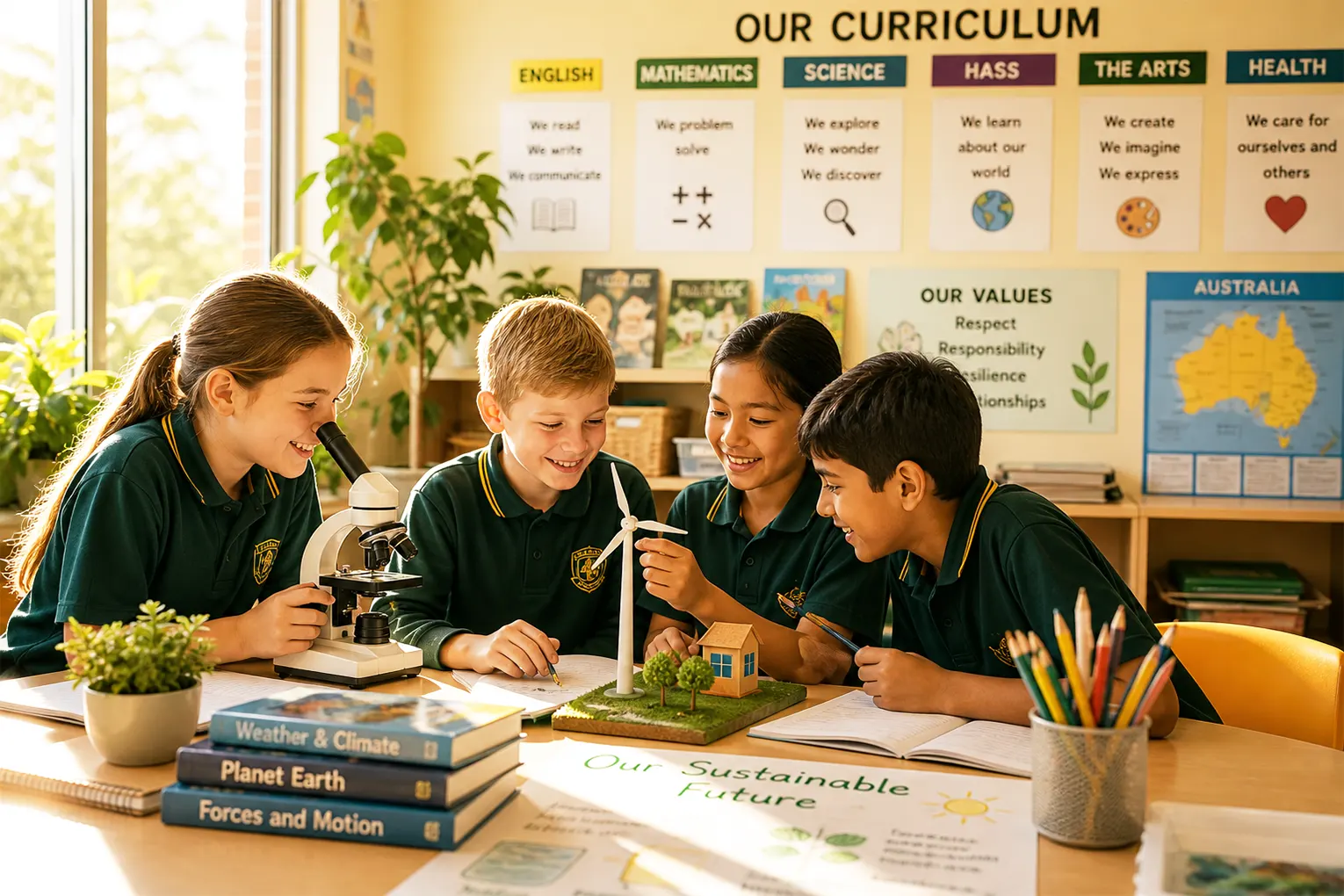
The Australian Curriculum is implemented in all states and territories (with some local adaptations). Primary school students study 8 key learning areas:
- English — Reading, writing, speaking, listening and viewing across all year levels.
- Mathematics — Number and algebra, measurement and geometry, statistics and probability.
- Science — Biological, chemical, physical, and Earth & space sciences through inquiry.
- HASS — Humanities and Social Sciences: history, geography, civics and economics.
- The Arts — Dance, drama, media arts, music, and visual arts.
- Technologies — Design and technology, digital technologies.
- Health & PE — Physical, social, mental health and wellbeing education.
- Languages — Schools may offer languages such as Mandarin, Italian, Japanese, French, or Indigenous languages.
NAPLAN in Primary School
NAPLAN (National Assessment Program – Literacy and Numeracy) is sat by all students in Years 3 and 5. Since 2023, NAPLAN takes place in Term 1. Results are reported on a proficiency scale and shared with parents, schools, and the public (via the My School website). NAPLAN is one data point — it does not determine a student's educational path.
Choosing Between Government, Catholic and Independent Schools
| Sector | Fees | Curriculum | Ethos | % of Students |
|---|---|---|---|---|
| Government | Free (residents) | State + Australian Curriculum | Secular, inclusive | ~65% |
| Catholic | Low–moderate | Australian Curriculum + faith | Values-based, community | ~20% |
| Independent | Moderate–high | Australian Curriculum + school philosophy | Varied (Montessori, Steiner, faith, elite) | ~15% |
All schools — regardless of sector — must implement the Australian Curriculum and meet ACARA and state education authority standards. The choice between sectors is ultimately about values, culture, fees and proximity.
Primary School Years by State & Territory
| State | First Year Name | Primary Years | Entry Age | Ends at |
|---|---|---|---|---|
| NSW | Kindergarten | K–Year 6 | 5 (by 31 Jul) | Year 6 |
| VIC | Prep | Prep–Year 6 | 5 (by 30 Apr) | Year 6 |
| QLD | Prep | Prep–Year 6 | 5 (by 30 Jun) | Year 6 |
| WA | Pre-primary | Pre-Primary–Year 6 | 5 (by 30 Jun) | Year 6 |
| SA | Reception | Reception–Year 6 | 5 (rolling intake) | Year 6 |
| TAS | Prep | Prep–Year 6 | 5 | Year 6 |
| ACT | Kindergarten | K–Year 6 | 5 (by 30 Apr) | Year 6 |
| NT | Transition | Transition–Year 6 | 5 | Year 6 |
Choosing the Right Primary School
What to Consider
- Location & catchment — Government schools enrol by zone; check your address at your state's education department website.
- School culture — Visit on an open day and speak with the principal and teachers about the school's values and approach.
- NAPLAN & My School data — Use myschool.edu.au to compare NAPLAN performance and ICSEA (socio-educational advantage) scores.
- Extracurricular programs — Sports, arts, STEM clubs, and language programs enrich the primary experience.
- Special needs support — Ask about learning support teachers, integration aides, and disability inclusion programs.
- Enrol early — Catholic and independent schools can have 1–3 year waitlists. Government schools accept enrolments up to 6 months before start date.
Frequently Asked Questions — Primary School
Search Primary Schools Near You
Browse our complete directory of Australian primary schools — filter by state, suburb, sector and more.