

Walk into any modern Australian classroom today and you are unlikely to find rows of students silently copying text from a chalkboard. Instead, you might find a group of Year 5 students collaborating to program a small robot, a Year 8 class 3D-printing prototype structures, or a Year 10 student designing a water-purification system to solve a real environmental problem.
This is STEM education in action — and it has fundamentally transformed the way Australian children learn Science, Technology, Engineering, and Mathematics. For parents choosing between schools, understanding how a school delivers its STEM program is fast becoming as important as reviewing NAPLAN results or checking school fees.
This guide explains exactly what STEM education means in the Australian context, why the government has made it a national priority, how it is taught across different year levels, and critically — what you as a parent can look for when evaluating schools.
According to the Australian Government's 2024 STEM Equity Monitor, 75% of the fastest-growing occupations in Australia require STEM skills. Employment in STEM-related fields is projected to grow at nearly twice the rate of non-STEM occupations over the next decade.
What Exactly Is STEM Education?
STEM stands for Science, Technology, Engineering, and Mathematics. However, describing STEM as simply "those four subjects" would be misleading. In Australian schools, STEM is a teaching philosophy and a learning approach as much as it is a subject cluster.
The core idea is integration. Rather than teaching each discipline in isolation — where science is science, and maths is maths — STEM education deliberately combines these fields to solve authentic, real-world problems. Students learn that in the real world, a structural engineer needs physics, mathematics, design thinking, and technology simultaneously. STEM replicates that reality in the classroom.
STEM vs. STEAM: What's the Difference?
Many Australian schools have expanded STEM into STEAM by incorporating "the Arts" — design, creative thinking, communication, and the humanities. The rationale is compelling: the engineers and scientists of tomorrow will need not only technical skills but also the ability to communicate ideas clearly, design user-friendly interfaces, and think ethically about the consequences of their work.
| Acronym | Stands For | What It Adds |
|---|---|---|
| STEM | Science, Technology, Engineering, Mathematics | Core technical and analytical skills |
| STEAM | STEM + Arts | Design thinking, creativity, ethical reasoning, communication |
| STREAM | STEAM + Reading/wRiting | Adds literacy and research skills — emerging in some schools |
Australia's National STEM Strategy
The Australian Government's commitment to STEM education is not rhetorical — it is backed by substantial policy and funding. The National STEM Education Strategy, developed through Education Ministers across all states and territories, sets out a coordinated approach to improving STEM outcomes from early childhood through to vocational and higher education.
Key elements of the strategy include:
- Gender equity: Closing the persistent gender gap in STEM participation, particularly in engineering, computing, and physics.
- Teacher capability: Significant investment in professional development for teachers, ensuring they can deliver high-quality, inquiry-based STEM learning.
- Industry partnerships: Direct connections between schools and STEM industries, providing real-world context and career pathways.
- Regional access: Ensuring that students in rural, remote, and regional Australia have access to the same quality of STEM education as metropolitan students.
How STEM Fits into the Australian Curriculum
STEM is embedded throughout the Australian Curriculum rather than existing as a separate subject. ACARA (Australian Curriculum, Assessment and Reporting Authority) has specifically designed the curriculum so that technology and engineering thinking are general capabilities that cut across all learning areas.
Primary School STEM (Foundation–Year 6)
In the early years of primary school, STEM is largely play-based and exploratory. The goal is not to produce young engineers — it is to build the foundational dispositions that make great STEM thinkers: curiosity, persistence, and comfort with trial-and-error.
| Year Level | Typical STEM Activities |
|---|---|
| Foundation – Year 2 | Sorting and classifying objects, simple coding using visual blocks (Scratch Jr), Bee-Bot programmable robots, observation journals, building challenges with blocks and recycled materials |
| Years 3–4 | Introduction to algorithms and sequencing, basic robotics (Sphero, LEGO WeDo), weather observations and data recording, simple electrical circuits, design-and-build challenges |
| Years 5–6 | Coding in Scratch or Python (introductory), LEGO Mindstorms robotics, spreadsheets and data analysis, bridge/structure engineering challenges, science experiments with variables and hypothesis testing |
Secondary School STEM (Years 7–12)
The transition to secondary school marks a significant step up in STEM complexity. Students begin to choose elective subjects, and the STEM pathway starts to diverge based on interest and aptitude.
Schools with strong STEM programs typically feature dedicated Innovation Labs or Makerspaces — purpose-built spaces equipped with:
- 3D printers and laser cutters
- Electronics workbenches and Arduino/Raspberry Pi kits
- Virtual Reality (VR) stations
- CAD (Computer-Aided Design) software
- Robotics kits (VEX, FIRST Robotics, etc.)
In senior secondary (Years 11–12), students can specialise in advanced STEM subjects aligned to their state's senior certificate. These selections directly influence ATAR scores and university entrance into competitive STEM degrees.
| State | Examples of Senior STEM Subjects Available |
|---|---|
| NSW (HSC) | Physics, Chemistry, Mathematics Advanced, Mathematics Extension 1 & 2, Software Design & Development, Engineering Studies |
| VIC (VCE) | Specialist Mathematics, Physics, Chemistry, Biology, Systems Engineering, Software Development |
| QLD (QCE) | Mathematical Methods, Physics, Chemistry, Information & Communication Technology, Engineering |
| WA (WACE) | Mathematics Specialist, Physics, Chemistry, Computer Science, Design & Technology |
When touring a school, go beyond the brochure. Ask to see the Makerspace or Innovation Lab. Is it well-equipped and actively used, or does it look pristine and untouched? Ask teachers: "Can you give me a recent example of a real STEM project your students completed?" A confident, specific answer indicates a genuinely strong program.
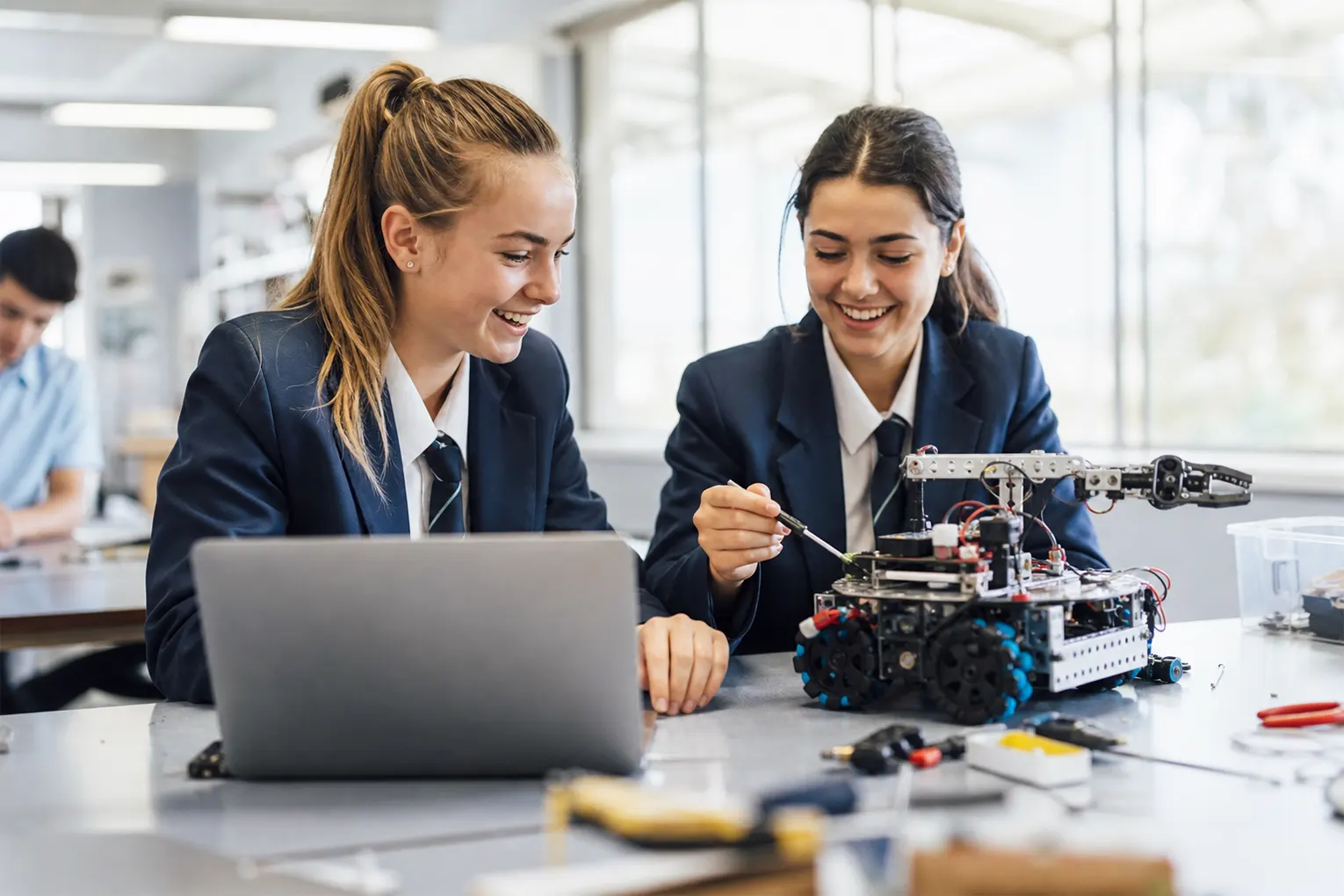
Closing the Gender Gap: Girls in Australian STEM
One of the most persistent challenges in Australian STEM education is the significant gender disparity that emerges in the senior years of high school. While girls perform equally well to boys in STEM subjects throughout primary school, by Year 11 and 12, female students are dramatically underrepresented in physics, advanced mathematics, and computing subjects.
The reasons are complex — a mix of social stereotyping, lack of visible role models, and classroom culture. The good news is that substantial, coordinated effort is going into fixing this.
| Initiative | Who Runs It | What It Does |
|---|---|---|
| Curious Minds | ANSTO & Defence | A residential mentoring program pairing high-achieving Year 9 & 10 girls with STEM professionals |
| Superstars of STEM | Science & Technology Australia | Creates visible female STEM role models who visit schools and speak at events |
| Code Club Australia | CSIRO | After-school coding clubs actively designed to include girls from primary school age |
| Women in STEM Ambassador Program | Australian Government | Funds women scientists and engineers to serve as visible ambassadors in schools and media |
| STEMGirls | Variety of NGOs and corporates | Career exploration events connecting girls with STEM professionals and industry |
STEM Competitions and Extracurriculars in Australia
Australia has a rich ecosystem of STEM competitions that give students the opportunity to apply their skills in high-stakes, exciting formats. Participation in these competitions is often a powerful indicator of a school's genuine commitment to STEM beyond the timetable.
- FIRST LEGO League: A team robotics and research challenge for students in Years 3–8. Teams design, build, and program a LEGO Mindstorms robot while also developing an innovative solution to a real-world problem.
- RoboCup Junior Australia: A national robotics competition structured around soccer, dance, and rescue missions.
- Australian Space Design Competition: Teams of secondary students design a realistic space habitat proposal — integrating engineering, science, and project management.
- ICAS (International Competitions and Assessments for Schools): Individual academic competitions in Mathematics, Science, Digital Technologies, and English.
- Science Talent Search: A research project competition in Victoria that has been running since 1958, producing numerous future scientists and engineers.
How Parents Can Support STEM at Home
You do not need a PhD in engineering to nurture a STEM mindset at home. The most powerful things parents can do are surprisingly simple.

Embed STEM in Everyday Life
- Cooking: Baking is chemistry. Doubling a recipe is fractions. Let your child measure, calculate, and predict what will happen when the bi-carb meets the vinegar.
- Gardening: Planting, observing growth, testing soil conditions, and monitoring water use are all genuine scientific inquiry processes.
- Building and making: LEGO, Magnatiles, K'Nex, and basic woodworking teach spatial reasoning, structural thinking, and the engineering design process through play.
- Questions, always questions: When your child asks "Why does the sky turn orange at sunset?" resist the urge to give an immediate answer. Ask: "What do you think? How could we find out?" This builds the investigative mindset that defines great STEM thinkers.
Making Screen Time Count
Not all screen time is equal. Help your child transition from passive consumption to active creation:
- Minecraft Education Edition: Teaches spatial design, logic, and — in the Education Edition — real coding concepts.
- Scratch (scratch.mit.edu): MIT's free visual programming platform. Students create their own games, animations, and interactive stories by learning real programming logic.
- Khan Academy: World-class, free mathematics and science instruction from Foundation level through to university-level content.
- Code.org: Free coding courses specifically designed for school-age children, aligned with the Australian Digital Technologies curriculum.
"The most successful STEM students I've taught weren't necessarily the ones who were naturally gifted at maths. They were the ones with the resilience to keep trying when their code failed or their bridge collapsed — the ones whose parents had taught them that failure is just data. You build that resilience at home, long before they ever walk into a Makerspace."
How to Evaluate a School's STEM Program
When comparing schools — particularly for secondary education — use this framework to assess the depth and authenticity of their STEM offering:
| Question to Ask | What a Strong Answer Looks Like |
|---|---|
| Do you have a dedicated STEM or Makerspace facility? | Yes, with specific equipment listed (3D printers, laser cutter, robotics kits) and evidence it is used regularly |
| Do students participate in STEM competitions? | Names of specific competitions (FIRST, RoboCup, ICAS) and recent results |
| How do you address the gender gap in STEM? | Specific programs for girls, women mentors, target enrolment in computing/physics |
| Do you have industry partnerships? | Named companies or universities, internship or work experience programs, visiting scientists |
| What % of Year 12 students take advanced STEM subjects? | A figure you can compare to state averages — higher means a stronger culture |
Ready to find a school with a strong STEM culture? Use our School Search to compare schools across Australia by state, type, and specialisation. You can also explore specific state directories to find schools known for their innovation programs in Victoria, New South Wales, and Queensland.
