
Bullying is one of the most persistent challenges facing Australian schools — and one of the most distressing experiences a family can go through. Whether your child is being bullied, has been accused of bullying, or you simply want to understand what protections are in place, this guide explains exactly how bullying prevention in Australian schools works, with a focus on the nationally recognised Bullying No Way! initiative and what it means in practical terms for students, parents, and educators.
What Is the "Bullying No Way!" Initiative?
Bullying No Way! is Australia's leading national online resource dedicated to the prevention of bullying in schools. It is a collaborative initiative supported by all Australian state and territory education authorities — both government and non-government — and is coordinated by Education Services Australia (ESA) on behalf of the education ministers.
The initiative operates year-round but reaches its highest public visibility during National Day of Action against Bullying and Violence (NDA), held annually on the third Friday of March. On this day, schools across the country run awareness activities, classroom discussions, and community events to reinforce a culture of respect and inclusion.
The core message of Bullying No Way! is simple but powerful: everyone in the school community — students, teachers, parents, and support staff — has a role to play in preventing and responding to bullying.
According to the Australian Child Wellbeing Project, approximately 1 in 4 Australian students reports being bullied at school. Cyberbullying now accounts for a growing proportion of incidents, particularly among students aged 10 to 15.
What Counts as Bullying? Understanding the Definition
One of the most important — and frequently misunderstood — aspects of bullying is the definition itself. Not every conflict, argument, or unkind act between students constitutes bullying. Australian schools use the following nationally agreed definition:
"Bullying is an ongoing and deliberate misuse of power in relationships through repeated verbal, physical and/or social behaviour that intends to cause physical, social and/or psychological harm."
— Australian Government / Bullying No Way!
The key components of this definition are:
- Ongoing and repeated: A single incident, while potentially hurtful or even requiring a disciplinary response, does not meet the threshold of bullying. The behaviour must be repeated over time.
- Deliberate misuse of power: The person bullying intentionally uses a real or perceived power imbalance (physical size, social status, access to information, group numbers) to harm, control, or exclude another person.
- Intent to harm: The behaviour is designed to cause distress, whether physical, social, or psychological.
This distinction matters enormously. When parents understand that not every negative interaction is bullying, they can respond more proportionately — and when a situation genuinely meets the criteria, they can advocate more effectively.
Types of Bullying in Australian Schools
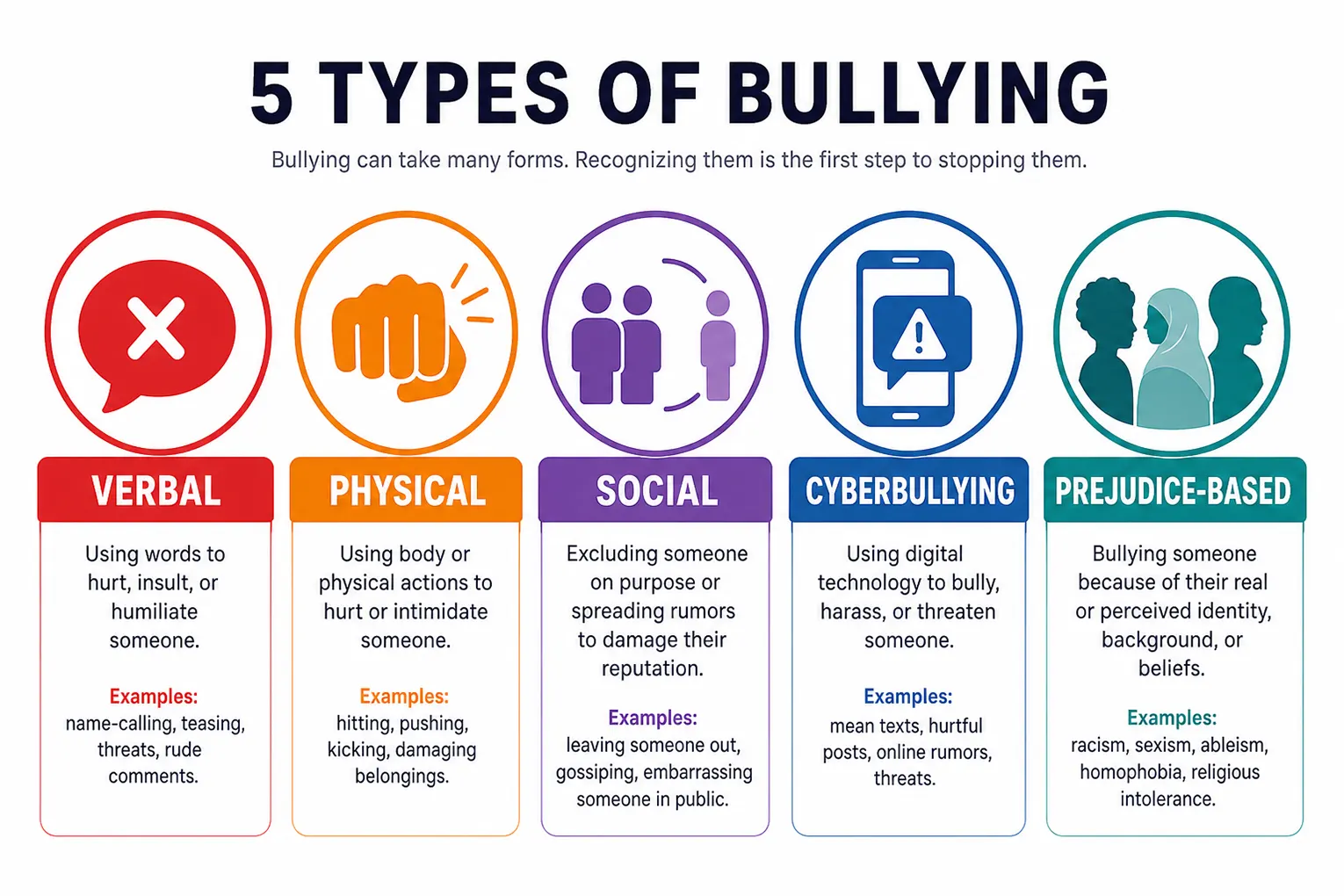
Bullying manifests in a range of forms across Australian schools:
| Type | Examples |
|---|---|
| Verbal | Name-calling, teasing, threats, derogatory comments about race, religion, gender, or appearance |
| Physical | Hitting, kicking, pushing, damaging or stealing belongings |
| Social / Relational | Deliberate exclusion, spreading rumours, manipulating friendships, public humiliation |
| Cyberbullying | Harassment via social media, messaging apps, gaming platforms, or email; sharing embarrassing images; creating fake profiles |
| Prejudice-based | Targeting a student because of race, religion, disability, gender identity, or sexual orientation |
What Are Schools Legally Required to Do?
Every Australian school — whether government, Catholic, or independent — has a legal and ethical obligation to provide a safe learning environment. This obligation is enshrined in state and territory education legislation, duty-of-care provisions, and the national Safe Schools Framework.
Under these obligations, schools must:
- Have a documented, publicly accessible anti-bullying policy that clearly defines bullying, outlines reporting procedures, and specifies consequences.
- Ensure that all staff are trained to recognise, respond to, and report bullying incidents.
- Implement proactive prevention programs — not just reactive responses — that foster a positive and inclusive school culture.
- Provide a clear reporting mechanism for students and parents, with a guaranteed follow-up process.
- Record all reported bullying incidents and track patterns over time.
- Involve parents meaningfully when their child is either being bullied or engaging in bullying behaviour.
Every Australian school must publish its anti-bullying or student wellbeing policy. If you cannot find it on the school website, you are entitled to request a copy directly from the principal. Before any meeting with school staff about a bullying concern, read this policy — it tells you exactly what the school has committed to doing.
Warning Signs That Your Child May Be Being Bullied
Children — particularly primary school-aged children — often do not disclose bullying directly. They may feel ashamed, fear retaliation, or believe nothing will change. As a parent, knowing the behavioural and emotional signals is critical to early intervention.
Signs in Primary-Age Children (Years 1–6)
- Unexplained reluctance to go to school or frequent complaints of stomach aches or headaches on school mornings
- Coming home upset, withdrawn, or unusually quiet after school
- Changes in friendship patterns — previously social children who suddenly have "no friends"
- Torn clothing, missing belongings, or requesting extra lunch money without explanation
- Nightmares, disturbed sleep, or bedwetting (in younger children) that begins without a clear medical cause
- Dropping grades or loss of interest in schoolwork
Signs in Secondary-Age Students (Years 7–12)
- Withdrawal from social activities they previously enjoyed
- Becoming secretive about their phone or online activity, or conversely, completely avoiding devices they previously used constantly
- Changes in mood after using social media — becoming distressed, angry, or tearful
- Declining school attendance, including unexplained absences or requests to visit the school nurse regularly
- Vague expressions of not wanting to be alive, or feeling hopeless — which must always be taken seriously
- Losing friendships abruptly and being unable to explain why
"The most valuable thing a parent can do is maintain an open, non-reactive conversation with their child about what is happening socially at school — not just once, but regularly. Children are far more likely to disclose a problem to a parent who has already demonstrated they won't panic or immediately escalate the situation." — Eleanor Hastings, Education Consultant
What to Do If Your Child Is Being Bullied: A Step-by-Step Guide
Discovering your child is being bullied triggers an understandably powerful protective response. Channel that energy into these concrete, effective steps:
Step 1: Listen First, Respond Second
Before taking any action, give your child uninterrupted space to tell you what has been happening. Avoid minimising ("kids will be kids") or catastrophising. Ask open questions: "Can you tell me more about what happened?" and "How long has this been going on?" Write down what they tell you — dates, names, specific incidents. This documentation will be essential later.
Step 2: Validate and Reassure
Make absolutely clear that what is happening is not their fault. Children who are bullied frequently internalise blame. Reassure them that coming to you was the right thing to do, and that you will work through this together. Avoid urging them to "fight back" or "ignore it" — both responses are often counterproductive and can escalate the situation.
Step 3: Contact the School — In Writing
Arrange a meeting with your child's classroom teacher or year-level coordinator. Before the meeting, send a brief written email outlining your concerns — this creates a paper trail. At the meeting, refer to the school's anti-bullying policy and ask specifically:
- Has this behaviour been observed by staff?
- What is the school's response plan and timeline?
- How will you be kept informed of progress?
Step 4: Follow Up
If the situation does not improve within two to three weeks, escalate to the deputy principal or principal. If you are dissatisfied with the school's response, contact your state or territory education department's student wellbeing team. Every state has a formal complaints and escalation pathway.

Cyberbullying: The Growing Challenge
Cyberbullying — bullying conducted through digital technologies — has become a major concern for Australian families. Unlike traditional bullying, it can follow a child home, occur 24/7, reach a wide audience, and leave a permanent digital record.
If your child is experiencing cyberbullying, take these additional steps:
- Screenshot and save all evidence before blocking or deleting anything.
- Report directly to the platform — all major platforms (Instagram, Snapchat, TikTok, Discord) have reporting mechanisms for harassment and abuse.
- Contact the eSafety Commissioner — Australia's Office of the eSafety Commissioner (esafety.gov.au) has the legal power to require the removal of harmful content and can assist with serious cases of image-based abuse or online threats.
- Report to police if threats of violence are made or if the content involves sexual imagery of a minor.
Australia is one of the few countries in the world with a dedicated government eSafety Commissioner with legal powers to act on online harms. If your school is not responding to cyberbullying, the eSafety Commissioner can be contacted directly at esafety.gov.au — free of charge.
What If Your Child Is Accused of Bullying?
Receiving a call from school saying your child has been bullying another student is confronting. Your first instinct may be to defend your child, but the most constructive response is to approach the situation with openness and responsibility.
- Listen to the school's account fully before responding. Gather the facts.
- Speak calmly with your child — not accusatorially. Ask open questions and listen for their perspective, while being clear that the behaviour described is unacceptable.
- Avoid dismissing the school's concern. Children frequently behave differently in peer groups than at home, and parents are not always aware of what is happening socially.
- Work with the school on a behaviour plan. Ask about restorative practice programs that help the child understand the impact of their actions and repair harm.
- Consider professional support — a school counsellor or psychologist can help identify underlying factors (social anxiety, difficulties at home, peer pressure) that may be contributing to the bullying behaviour.
Building a Bullying-Prevention Culture: How Schools Do It
The most effective anti-bullying programs are not reactive — they are built into the fabric of school culture through everyday practices. Australian schools aligned with the Bullying No Way! framework implement:
- Positive Behaviour Support (PBS): A whole-school framework that explicitly teaches and reinforces prosocial behaviours, with consistent expectations across classrooms, playgrounds, and corridors.
- Peer support programs: Older students are trained to mentor and support younger students — a highly effective strategy for reducing social exclusion.
- Student wellbeing curricula: Dedicated lessons in resilience, emotional regulation, respectful relationships, and bystander responsibility (teaching students how to safely respond when they witness bullying).
- Regular surveys and check-ins: Anonymous student wellbeing surveys help schools identify hidden patterns of bullying that students may not report directly.
- Restorative practices: Rather than purely punitive responses, restorative circles and mediated conversations help all parties process the harm done and agree on how to move forward.
State-by-State Support Resources
Each Australian state and territory offers specific resources and escalation pathways for bullying concerns:
| State/Territory | Key Resource |
|---|---|
| NSW | NSW Department of Education — Student Wellbeing & Anti-Bullying |
| VIC | Department of Education — Bully Stoppers Program |
| QLD | Department of Education — Safe Schools Hub |
| WA | Department of Education — Protective Behaviours Program |
| SA | Department for Education — Wellbeing for Learning |
| TAS | Department of Education — School Support Services |
| ACT | Education Directorate — Student Engagement & Inclusion |
| NT | Department of Education — Student Wellbeing Advisors |
In addition to these government resources, the national bullyingnoway.gov.au website provides age-appropriate resources for students, evidence-based guidance for parents, and professional development tools for educators.
Key Takeaways for Parents
Bullying is a real and serious issue in Australian schools — but it is one that the education system is actively and systematically working to address. The Bullying No Way! initiative, combined with state-based wellbeing frameworks, provides a strong national foundation. As a parent, your role is to stay informed, maintain open communication with your child, and know when and how to engage with your school.
The most important message to give your child — whatever their experience — is that they are not alone, that you believe them, and that there are adults both at home and at school who are on their side.
